

Warehouse Inventory Verification
Inventory control you can trust
Continuously verify physical warehouse inventory against your WMS or ERP - without relying on manual stock checks
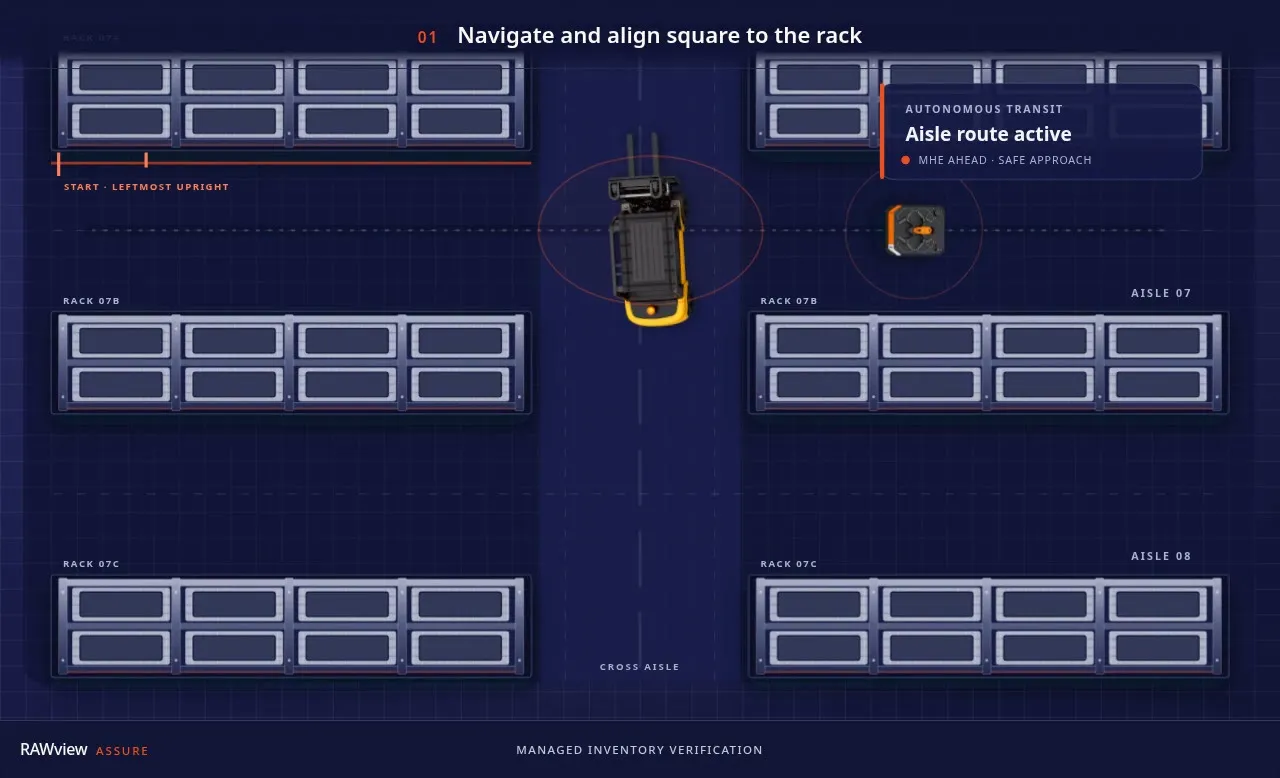
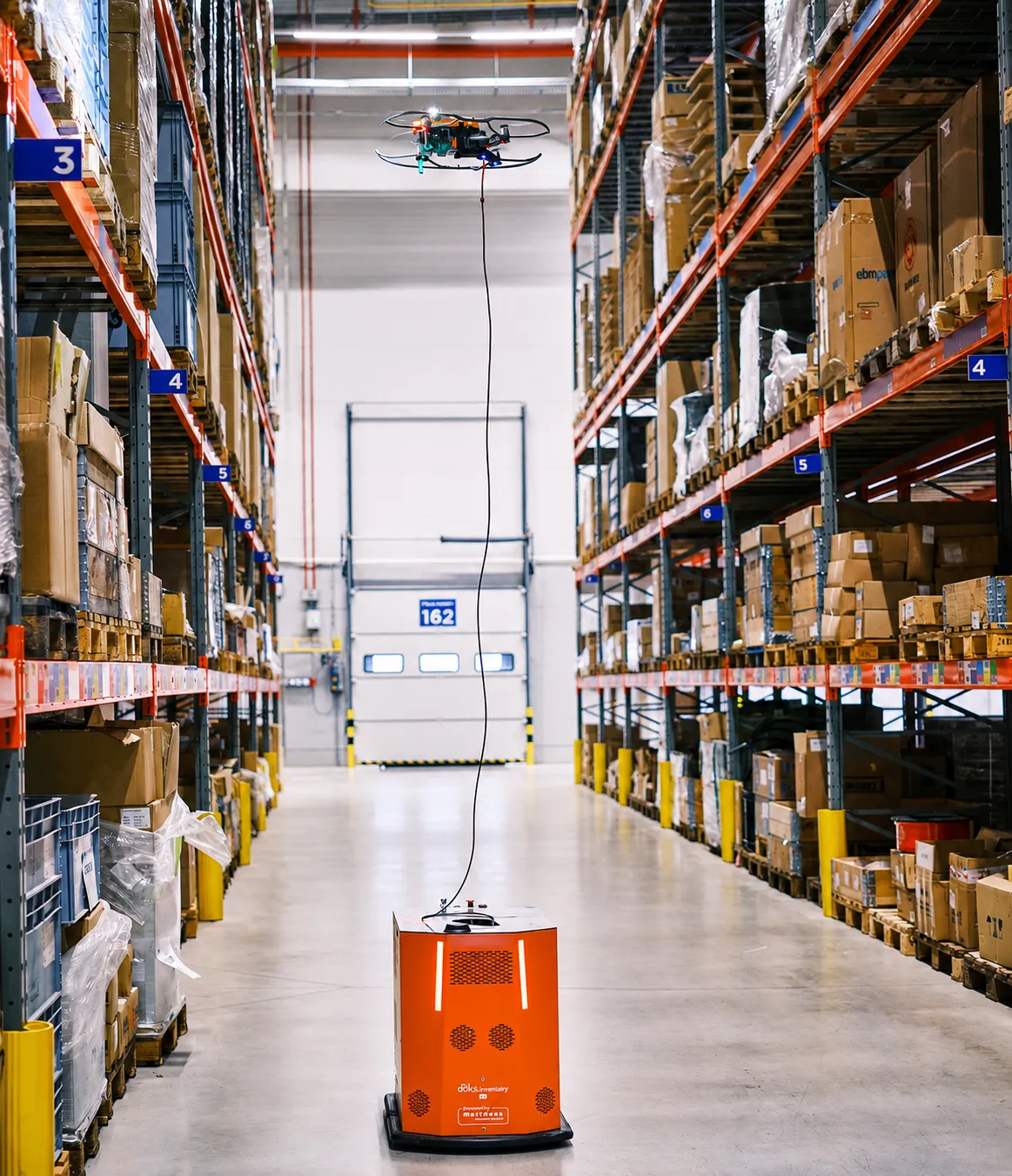
The autonomous system operates from your site for the agreed service term.
Pallet locations are checked on a programmed schedule or operating cycle.
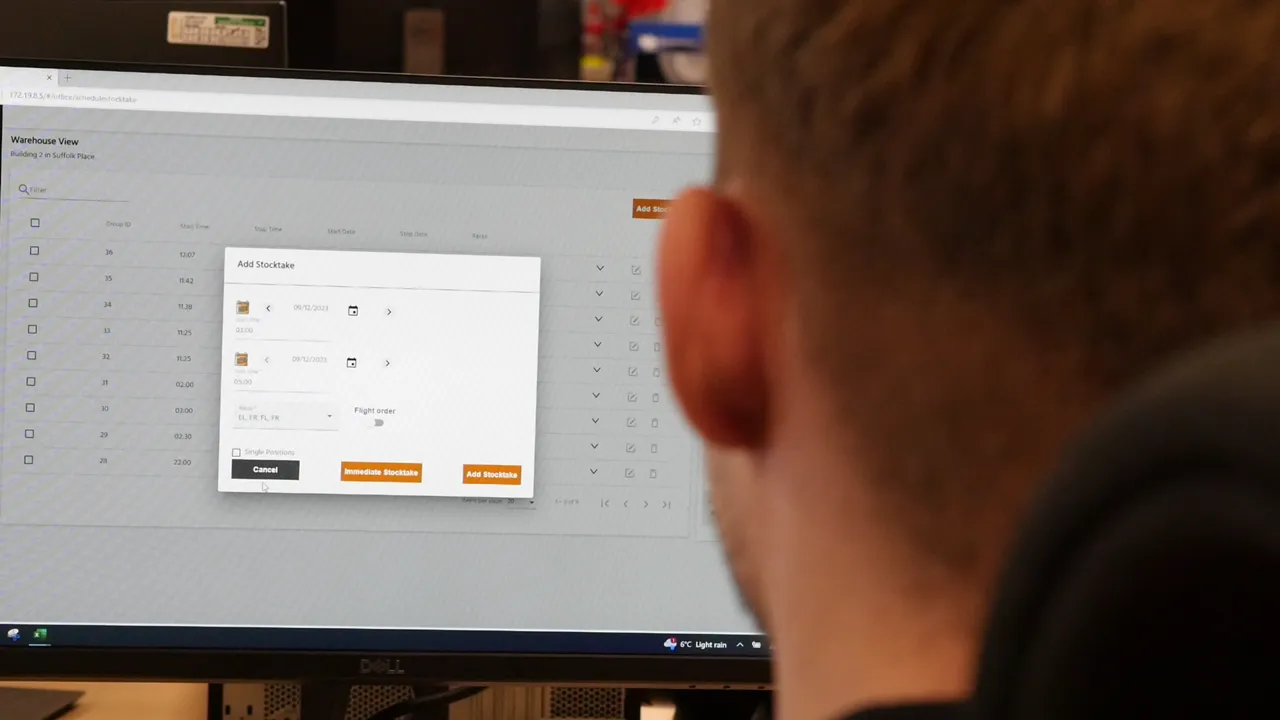
Observed inventory is compared with expected system records to identify discrepancies.
We monitor, manage and support the service on your behalf.
Ongoing Warehouse Stock Control, Not a One-Off Stocktake
Physical data capture
The system captures pallet identifiers and assigns them to the storage locations in which they are physically observed.
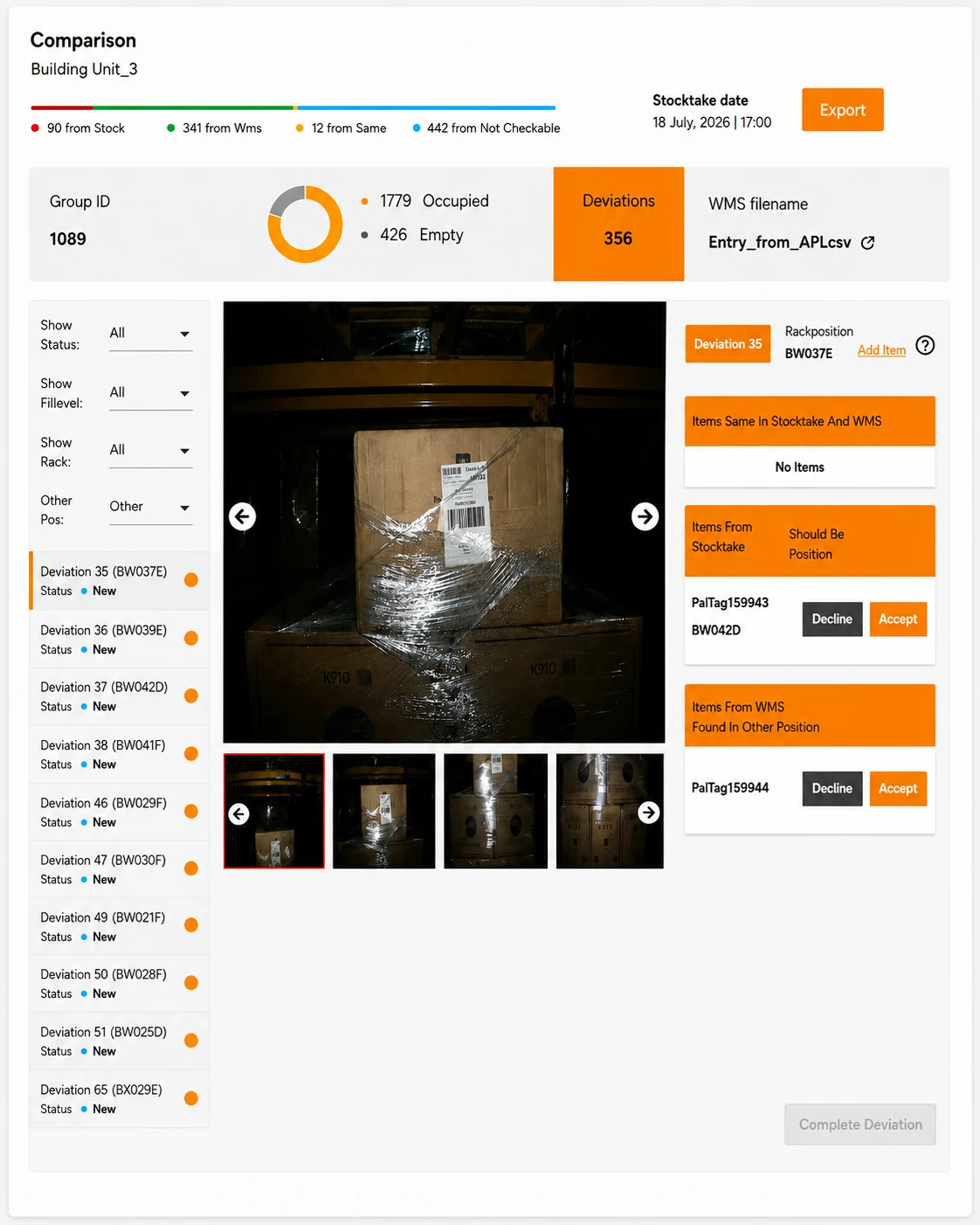
WMS or ERP comparison
Observed pallet locations are compared with expected system records to identify mismatches.
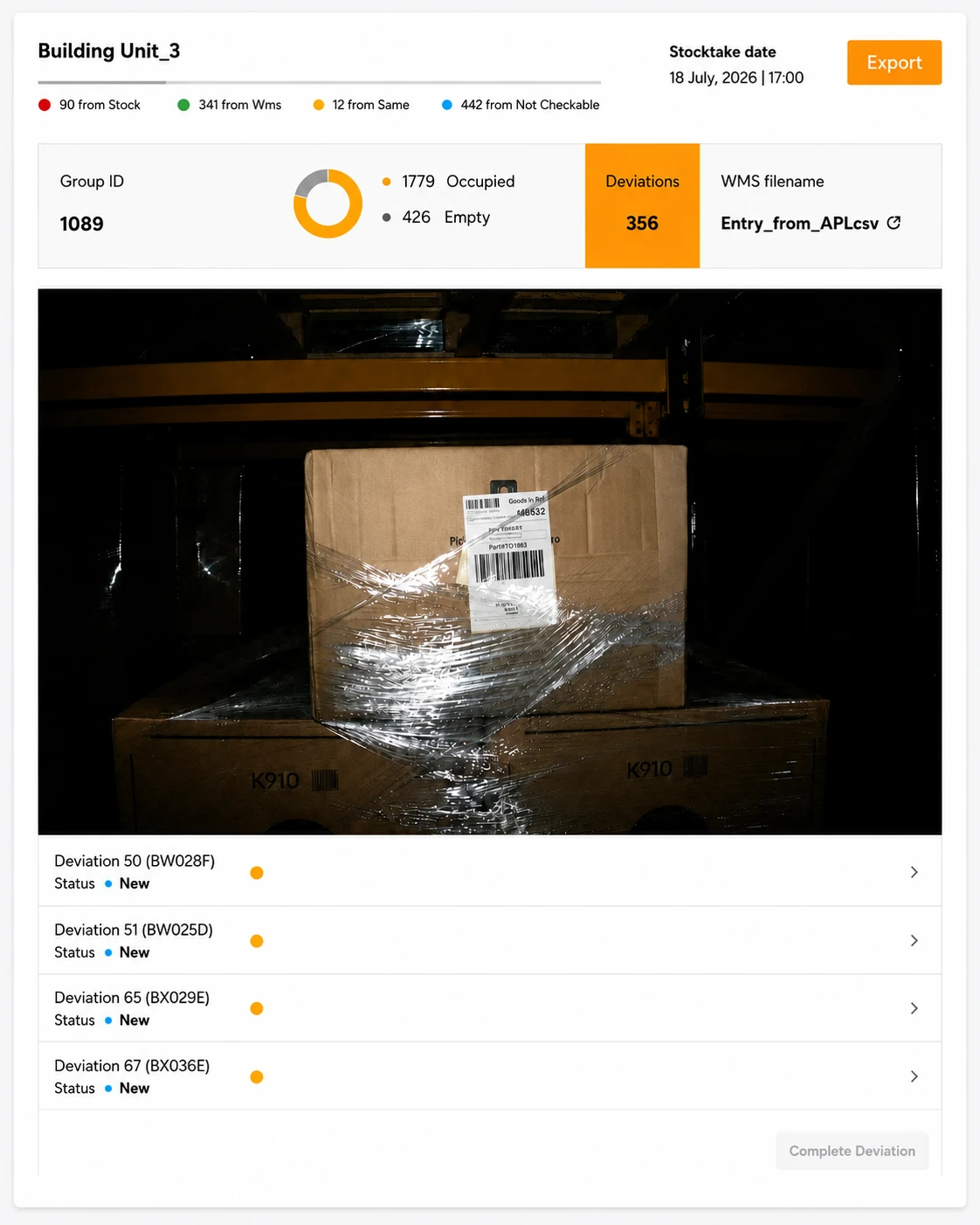
Evidence-backed exceptions
Discrepancies are supported by time-stamped visual and barcode evidence for investigation.
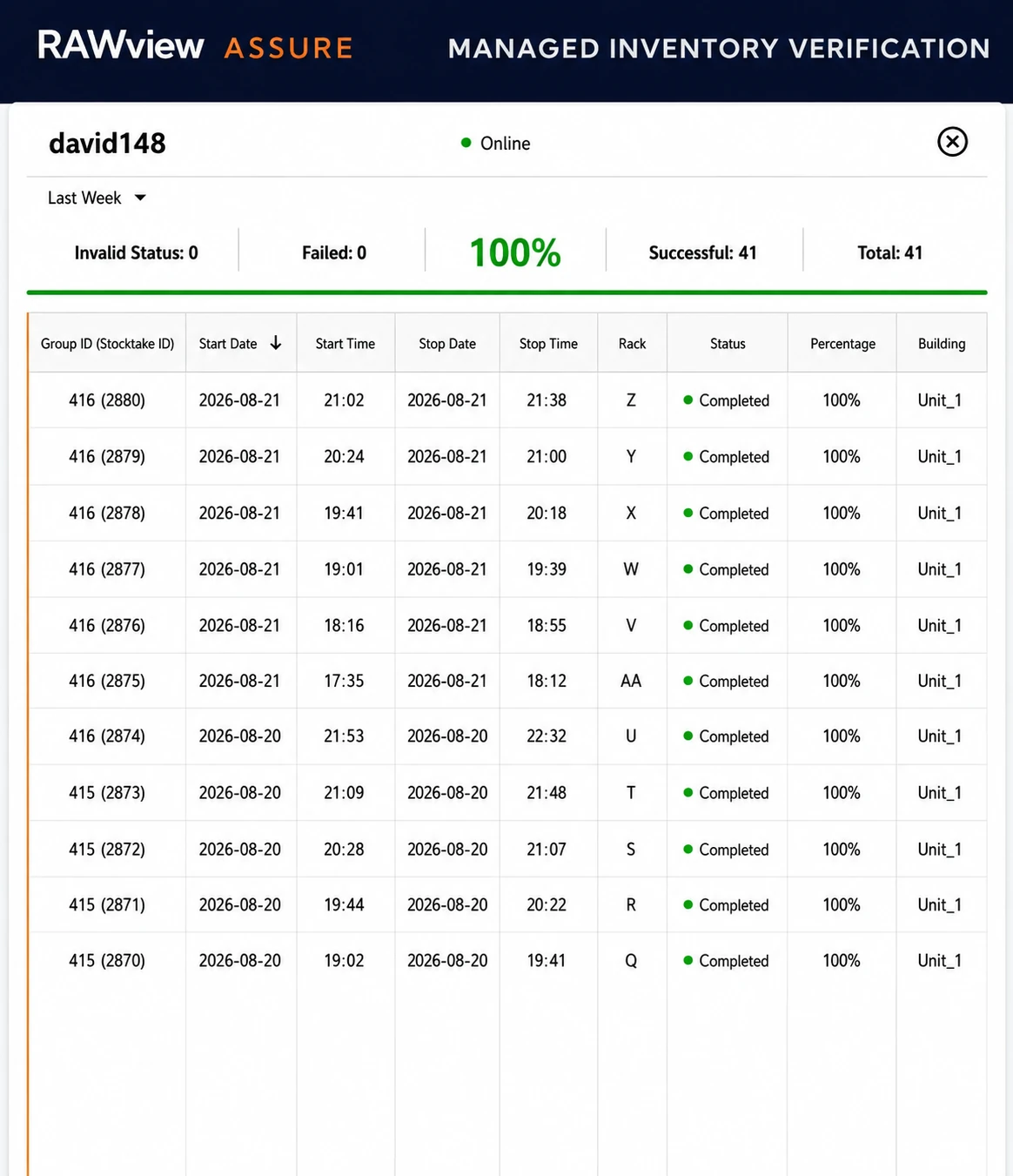
Managed service delivery
RAWview monitors the service, tracks coverage and performance, and supports improvement over time.






What Happens When Physical Inventory No Longer Matches Your WMS?
Picking delays. Emergency searches. Recounts. Customer disputes. Write-offs. Audit pressure.
Warehouse operations depend on reliable inventory data. When pallets move, are misidentified or become unreadable without the corresponding system record being corrected, physical reality and WMS data begin to diverge.
Manual stock takes and cycle counts provide only a point-in-time snapshot. Between checks, discrepancies can accumulate unnoticed.
The difference between what your WMS records and what is physically verified is the Inventory Assurance Gap.
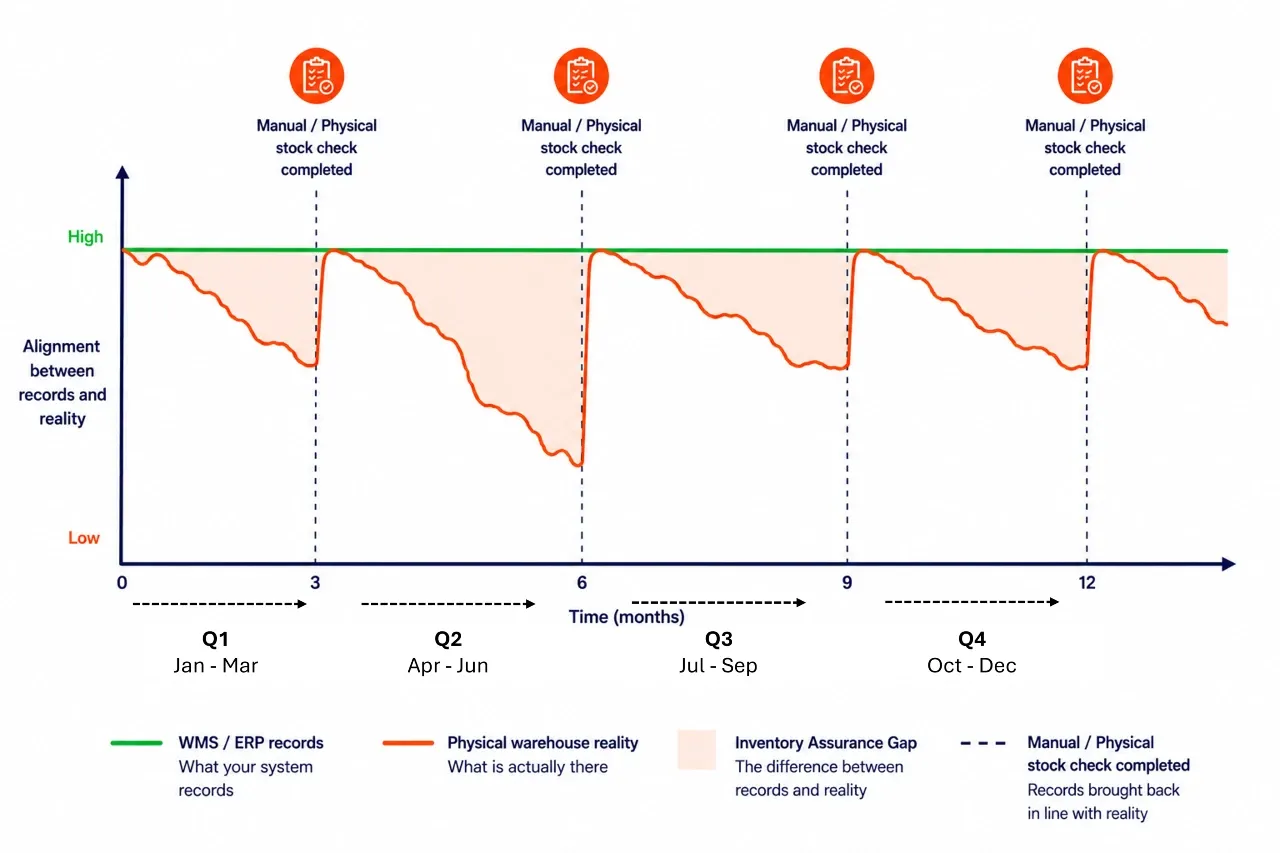
Click image to expand
Assess Your Current Inventory Controls
Find the Gaps Before They Cost You
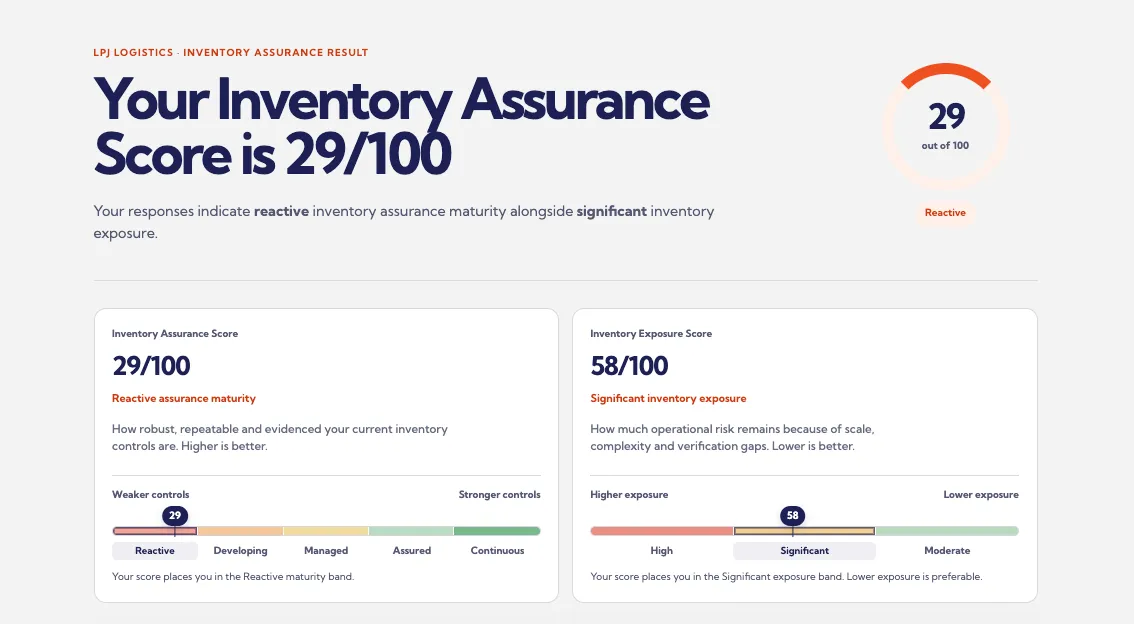
How confidently can your organisation demonstrate that physical inventory matches its WMS records?
Complete our Inventory Assurance Health Check to receive a score out of 100, identify weaknesses in your current controls and see where improvement should be prioritised.

From Scope to Inventory Assurance in Four Simple Steps
RAWview manages the technology, deployment and ongoing support. You agree what needs verifying - we take care of the rest.
Agree what to verify
Together, define the locations, pallet identifiers, exceptions and frequency that matter.
Deploy RAWview Assure
RAWview configures the system for the warehouse and prepares the agreed verification service.
Start repeated verification
Physical inventory is automatically checked against expected WMS or ERP records.
Act on what matters
Teams receive evidence-backed exceptions and recurring insight to investigate problems earlier and improve inventory control.
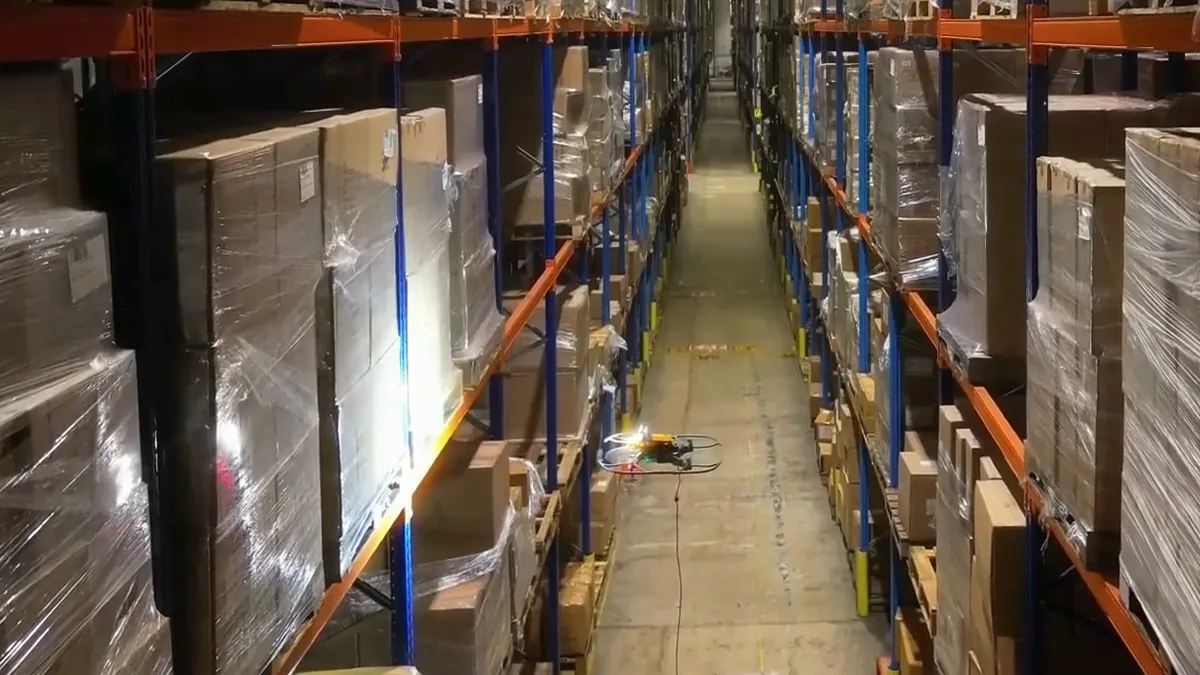
No drone operators. No robotics team. No additional operational system to manage. RAWview monitors and maintains the service on your behalf.
Book an Inventory Assurance ReviewInventory Discrepancies Rarely Stay Contained
The cost appears through labour, delayed operations, customer disputes, write-offs and audit effort.
Weak inventory verification creates costs that go far beyond stock-counting labour - in the form of searches, disruption, customer disputes, write-offs and audit effort. As the Inventory Assurance Gap widens between checks, those costs can accumulate unnoticed.
Labour & operations
- Routine shutdowns
- Inventory searches
- Recounts & disruption
- Working at height
Disputes & write-offs
- Late discovery
- Weak evidence
- Costly resolution
- Avoidable recounts
Audit & compliance
- Reactive investigation
- Reduced visibility
- Poor traceability
- More preparation
RAWview Assure Live in Complex Warehouses
RAWview inventory automation is already operating in live logistics, manufacturing and distribution environments. See how customers are using it to strengthen inventory control.



"With the introduction of RAWview's solution, all 16,000 pallet locations are now automatically audited every 5 days. Previously, it took one person and a scissor-lift three to four weeks to complete the same task."
Genpower
Roland Llewellin, Chief Executive Officer
“The speed of our scanning time has improved well over 100%. It’s these kind of efficiency improvements that we feel is vital to future proofing our operation and ensure that we continuously meet the demands of our customers by staying ahead of the curve.”
Knowles
Alex Knowles, Managing Director, Knowles Logistics

"The future of warehousing! What an amazing, well-engineered piece of technology that not only saves time and improves our team's productivity, but also has a positive impact in regards to Health and Safety."
PD Ports
Jonathan Borg, Stock Control & Systems Manager

"Thanks to RAWview, we've been able to streamline our operations, reduce human error, and improve our customer satisfaction. We'd highly recommend to any business looking to upgrade their stock control processes."
GS Yuasa
Anthony Mazzotta, Finance & Operations Manager
Autonomous Warehouse Inventory Drone and Ground Robot
Built to verify pallet locations across low-level and high-bay racking, autonomously and at scale.
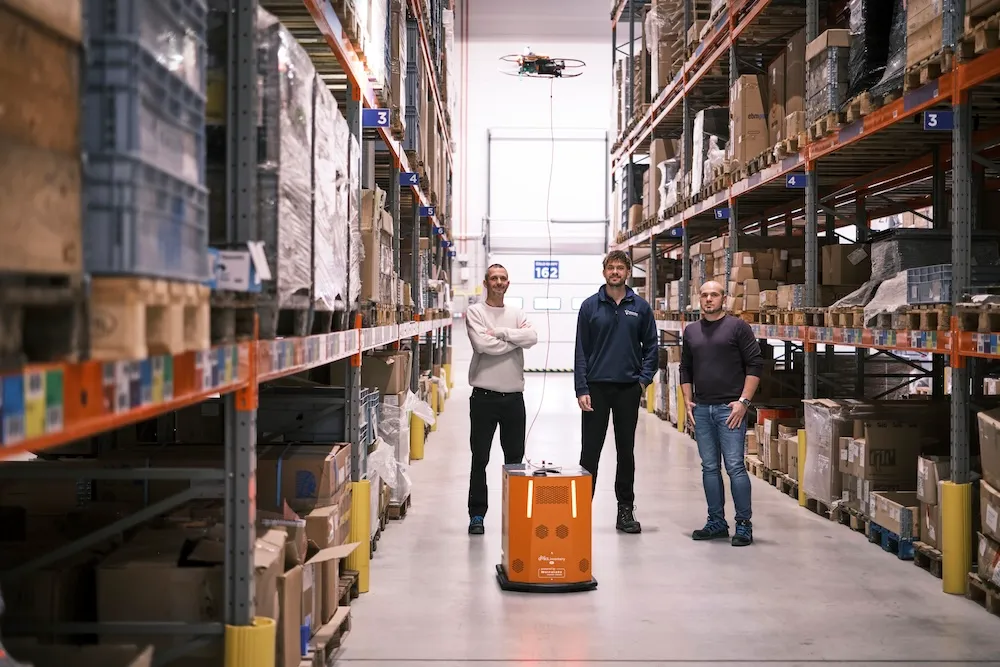
RAWview Assure combines an autonomous ground robot with a tethered drone to capture pallet identifiers and confirm their physical storage locations throughout the warehouse.
The system operates through scheduled aisles, returns automatically to charge and is remotely monitored by RAWview. Verification results can be reviewed securely, exported into existing workflows or integrated with WMS and ERP systems.
Observed pallet-identification accuracy.
Locations verified during a 24-hour operating window.
Supported high-bay verification height.
Stronger Inventory Control, Consistently Measured
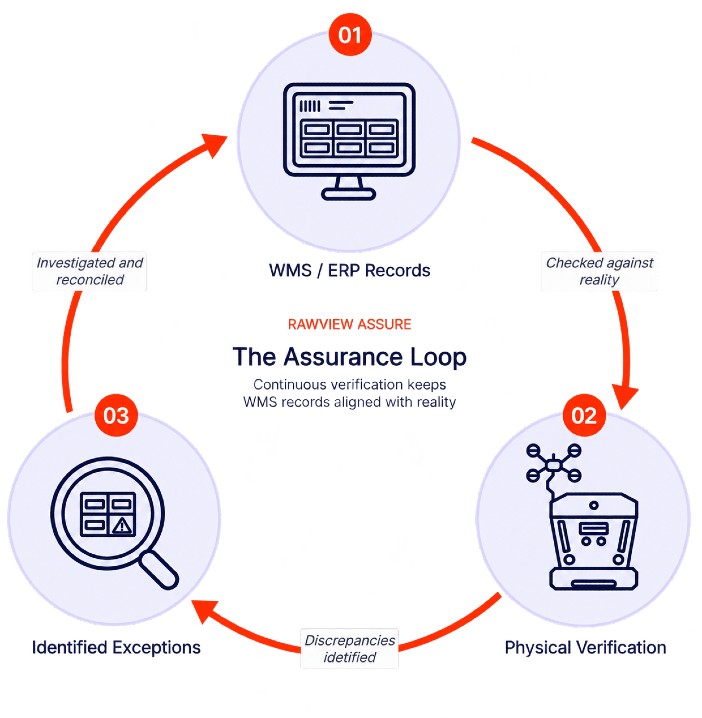
RAWview Assure creates a continuous verification loop between physical warehouse reality and your WMS or ERP - identifying discrepancies, supporting reconciliation and strengthening inventory control over time.
Broader verification coverage
Check more pallet locations, more often, without adding manual counting effort.
Earlier discrepancy detection
Spot missing, unexpected and unreadable inventory sooner.
Faster investigation and resolution
Reconcile physical checks with system records using time-stamped barcode evidence.
Stronger control over time
Track recurring exception patterns, reveal process weaknesses and demonstrate measurable improvement against the baseline.
One Managed Service, Different Operational Outcomes
Inventory & Stock Control Managers
Increase physical verification coverage and identify inventory exceptions earlier.
- Check more pallet locations without scaling manual count teams.
- Detect missing, misplaced, duplicated and unreadable inventory.
- Compare physical observations with WMS or ERP records.
- Retain evidence for investigation and reconciliation.
- Track exception ownership, resolution and recurrence.
Logistics & Operations Leaders
Maintain confidence in inventory accuracy without increasing operational burden.
- Verify pallet locations on an agreed schedule alongside live activity.
- Reduce reliance on night shifts, access equipment, manual stocktakes and routine cycle counting.
- Identify exceptions before they become pick failures or customer issues.
- Increase verification coverage without proportionately increasing labour.
.webp)
IT & WMS Managers
Add automated warehouse inventory verification without replacing established systems.
- Configure the service around existing location and pallet-identifier structures, including licence plate numbers where used.
- Support agreed 1D and 2D barcode formats and, where included in scope, Optical Character Recognition (OCR) of agreed human-readable identifiers.
- Review outputs through a secure interface, data export or agreed API integration.
- Retain established WMS, ERP and operational workflows.
.webp)
Finance, Risk & Audit Leaders
Strengthen confidence in inventory records, controls and supporting evidence.
- Establish a verified baseline of physical inventory.
- Identify exposure before audit or customer escalation.
- Support stock valuation, write-off and reconciliation decisions.
- Track assurance improvement against agreed measures.
.webp)
Health & Safety Leaders
Reduce working-at-height exposure and avoidable pedestrian–MHE interaction during routine inventory checks.
- Reduce reliance on lifts and MHE for high-level stock checks.
- Reduce the need for employees to enter active MHE operating areas for routine data capture.
- Keep employees focused on exception resolution rather than repetitive verification activity.
- Schedule verification during agreed live or out-of-hours operating windows.
- Maintain evidence of completed verification activity.
.webp)
ESG & Sustainability Leaders
Support safer, less resource-intensive inventory verification.
- Reduce routine MHE use for high-level inventory checks.
- Replace manual and paper-led verification activity.
- Reduce unnecessary recounts, searches and repeat journeys.
- Generate operational information that may support internal sustainability reporting.
.webp)
Where Inventory Risk Shows Up in Practice
The Inventory Assurance Gap rarely appears as one obvious problem. It usually becomes visible through recurring operational symptoms caused by physical inventory no longer matching WMS or ERP records.
Explore the areas where weak inventory assurance most commonly affects warehouse operations.
Featured Insight The Inventory Assurance Gap
Audit risk
How to prove warehouse inventory accuracy, reduce audit disruption and maintain evidence-backed verification between formal stock audits.
Inventory disputes
Why warehouse inventory discrepancies arise and how time-stamped evidence helps resolve stock disputes faster and prevent repeat issues.
Manual stock count and cycle-count limitations
Compare manual stock counts and cycle counting, including their labour, disruption and safety risks, with repeatable independent verification.
Operational change risk
Protect inventory accuracy during WMS migrations, warehouse moves and process changes with independent verification throughout the transition.
TAKE THE NEXT STEP
Book an Inventory Assurance Review
Choose the right next step for your warehouse.
Ready to talk? Book a review to explore your current inventory controls and see how RAWview Assure could strengthen them. Prefer to benchmark first? Complete the Inventory Assurance Health Check to get your score.
RAWview Assure FAQs
What is RAWview Assure?
RAWview Assure is an ongoing managed warehouse inventory-verification service.
It uses an autonomous warehouse inventory drone and ground robot to capture physical pallet and location information, compare it with WMS or ERP records and identify discrepancies supported by time-stamped evidence.
The system is deployed at the customer’s warehouse, while RAWview remains responsible for monitoring and supporting the service.
Is RAWview Assure a one-off stocktake or audit service?
No. RAWview Assure is an ongoing managed inventory-verification service.
An autonomous system is deployed at the customer’s warehouse and performs repeated checks against an agreed scope and schedule. RAWview manages, monitors and supports the service throughout the agreed service term.
The Inventory Assurance Site Diagnostic is a defined initial assessment used to establish the baseline and deployment requirements. It should not be confused with the ongoing RAWview Assure service that follows.
RAWview Assure strengthens audit evidence and readiness, but it is not a statutory audit or certification service.
How do warehouse inventory drones support inventory management?
Warehouse inventory drones capture pallet identifiers and physical storage locations across racking, including high-level positions that can be costly, disruptive or difficult to check manually.
RAWview Assure combines an autonomous warehouse inventory drone with a ground robot to perform repeated checks across an agreed warehouse scope.
The observed inventory is compared with expected WMS or ERP records, allowing discrepancies to be identified and investigated using time-stamped visual and barcode evidence.
Unlike standalone inventory drones, the technology is deployed and managed by RAWview as part of an ongoing service.
Can RAWview Assure automate stock taking and cycle counting?
RAWview Assure can reduce reliance on routine manual stock taking, inventory counting and cycle counting by performing repeated automated checks across an agreed warehouse scope.
The service can check more pallet locations more frequently without proportionately increasing manual counting effort, access-equipment use or headcount.
It is delivered as an ongoing managed warehouse stock-control service—not as a temporary replacement for a single year-end stocktake or statutory audit.
How are physical pallet locations compared with WMS or ERP records, and what discrepancies can be identified?
The autonomous system captures pallet identifiers together with the storage locations in which they are physically observed across the agreed warehouse scope.
Observed positions are compared with expected WMS or ERP records. Depending on the customer’s data, identifier structure and agreed scope, RAWview Assure can flag:
- missing inventory;
- unexpected inventory;
- misplaced pallets;
- duplicated identifiers;
- unreadable barcodes or agreed human-readable identifiers.
Exceptions are flagged for investigation rather than silently inferred. Results can be reviewed through a secure interface, exported into established workflows or integrated with existing systems according to the agreed deployment scope.
Can the system operate alongside live warehouse activity?
Yes. The technology is designed to operate within defined routes and controlled operating behaviours inside live warehouse environments.
Verification can be scheduled during live activity or during agreed out-of-hours windows, depending on the site assessment, operating conditions and customer requirements.
Deployment is planned to minimise disruption, reduce reliance on routine manual checks and limit avoidable pedestrian–MHE interaction.
Does RAWview Assure integrate with existing WMS or ERP systems?
RAWview Assure is designed to work alongside existing WMS and ERP platforms rather than replace them.
Verification results can be reviewed through the RAWview interface, provided through agreed data exports or integrated through an API or other interface where this forms part of the deployment scope.
Any required data access, mapping and workflow changes are defined during the Site Diagnostic and implementation planning.
How does RAWview Assure reduce operational costs and risk?
The cost of poor inventory verification is rarely limited to the labour used for stock counts. It also appears through emergency searches, picking delays, rework, customer disputes, write-offs, audit preparation, avoidable capacity loss and management time spent investigating discrepancies.
RAWview Assure reduces the direct effort and disruption associated with routine cycle counting, while identifying discrepancies before they affect fulfilment, customer service or operational planning. It allows more warehouse locations to be checked more frequently without proportionately increasing manual stock-counting effort or headcount.
The commercial value can come from both direct savings and avoided exposure:
- Less manual counting, access-equipment use and operational disruption.
- Fewer unresolved discrepancies, emergency searches and avoidable recounts.
- Earlier identification of misplaced, missing or unexpected inventory.
- Stronger evidence when resolving customer disputes or preparing for audits.
- Reduced risk of inventory errors creating service failures, penalties, write-offs or lost capacity.
Doing nothing does not preserve the current situation. It allows the gap between physical inventory and system records to continue generating hidden operational and financial cost.
Where a business case is required, RAWview supports the development of it from validated information gathered during the Inventory Assurance Site Diagnostic. This ensures the business case reflects the customer’s actual warehouse, processes and exposure rather than guessed inputs or generic savings assumptions.
What types of warehouse are suitable, and what does the customer need to provide?
RAWview Assure is suitable for many palletised warehouse and storage environments, including logistics, manufacturing and distribution operations where inventory accuracy, high-bay verification and auditability are important.
Suitability depends on factors such as racking configuration, aisle access, barcode or identifier standards, site connectivity, operating conditions and the availability of relevant WMS or ERP data.
Customer requirements typically include:
- suitable pallet identifiers;
- safe aisle access;
- a charging-dock location and power;
- agreed connectivity;
- relevant WMS or ERP data;
- defined operating windows.
RAWview assesses these requirements before recommending a deployment.
How is the managed service supported and maintained?
RAWview remains responsible for system monitoring, software updates, operational support and technical maintenance throughout the agreed service term.
Site teams are not expected to fly the drone or manage the underlying robotics. RAWview monitors system health, service delivery, coverage and exceptions, with responsibilities and support arrangements defined during deployment planning.
